Papelina
1975 - 1978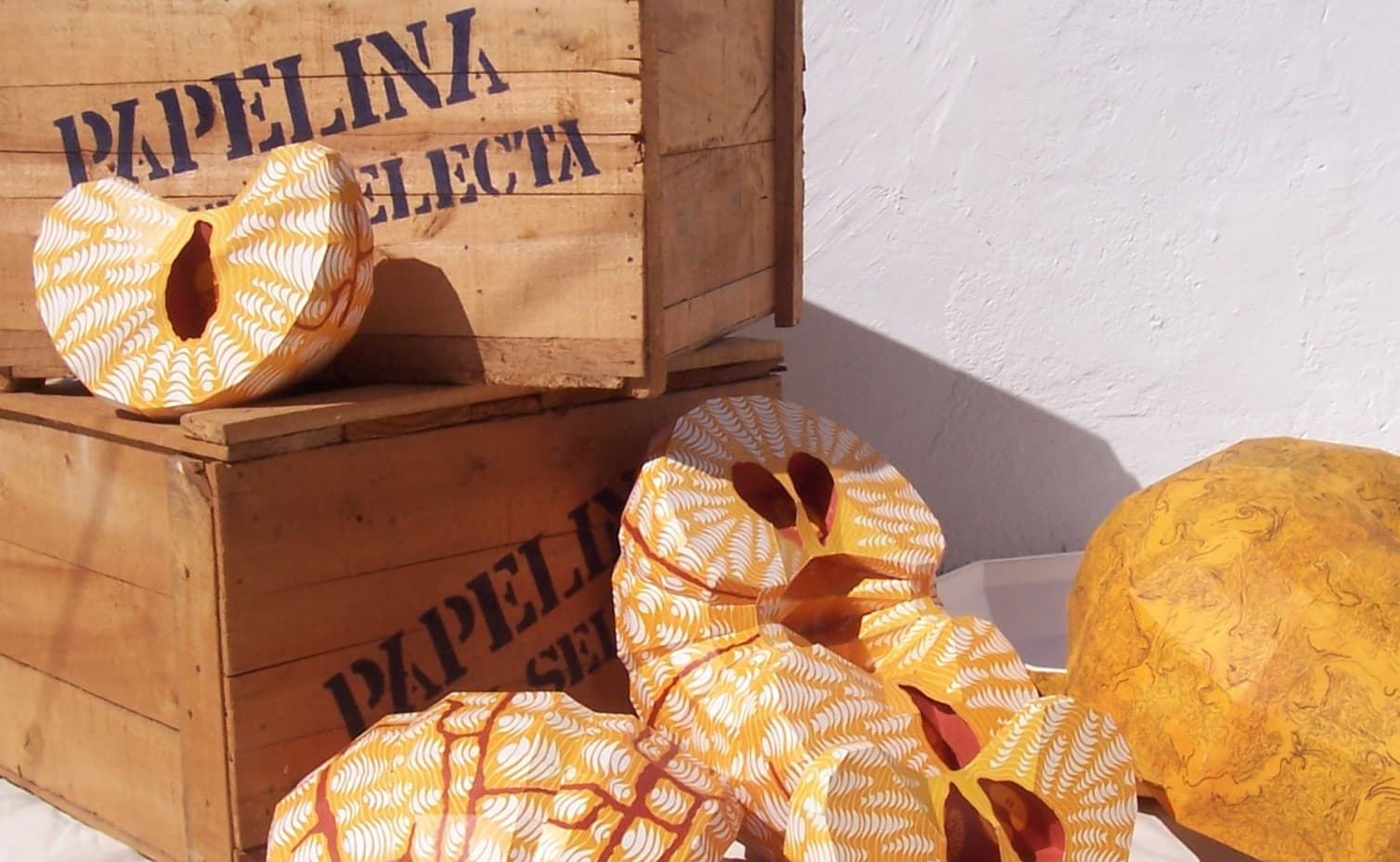
La Papelina es el resultado del trabajo final realizado en la entonces denominada Facultad de Bellas Artes, hoy Facultad de Artes, que tenía el propósito de realizar el estudio de un elemento natural para generar otro nuevo, similar al estudiado, que pudiese insertarse dentro de la naturaleza como una especie creada por el ser humano. Se eligió el fruto de la mandarina y haciendo un estudio morfológico de sus partes, se buscó la manera de crear una nueva especie construida con papeles impresos para tal fin.
En primer lugar se hicieron dibujos de diferentes cortes y partes del fruto, tomando medidas realizando las observaciones que se consideraban de interés para el proyecto.


Después de realizar variedad de estudios se comienza a proyectar la manera de construir un objeto similar con papeles recortados, doblados y pegados. En un principio se trató de llegar a un resultado aceptable a través de sucesivos ensayos, corrigiendo errores. Pero fue imposible. Entonces se decidió abordar el estudio de Geometría descriptiva, para partir de proyecciones y buscar las medidas reales de cada uno de los planos.
Diez gajos de papel, de características similares y una caja contenedora, también de papel, que reprodujera el formato externo del fruto fue el resultado que se logró después de tres meses de estudio y trabajo.


Realizado el diseño básico de las partes del nuevo fruto, se diseñan los aspectos superficiales de los volúmenes. Diversidad de texturas se prueban como posibles para realizar las diferentes matrices.


Decidido el diseño final se realizan las matrices para imprimir las diferentes partes. Para los gajos se hacen planchas de yeso que se graban para realizar impresiones manuale del relieve. Para las cáscaras se graban al aguafuerte y aguatinta planchas de zinc.
Una vez realizadas las estampas se marcan, cortan, doblan y pegan, creando tres ejemplares de diferentes características.
Cajones de madera impresos con stencil resguardan cada uno de los ejemplares.
Hay varios textos que acompañan el proceso de trabajo. Se transcribe aquí un poema.
Quisiera tener algo más que lo infinito
para recortarlo, doblarlo y armarlo
a mi antojo.
Crear la forma sin final
que sea una caricia cálida.
Descubrir el color que aún es secreto
por obra de los indiferentes y abúlicos
– que son más que muchos –
para imprimirle el matiz preciso
que genere luz difusa.
Hacer un objeto que sea un variar constante
concretar lo indefinido viviente,
que retumben sus latidos
y deje a su paso
una estela de ínfimas partículas sonoras.
Quisiera crear un mundo
que quepa en la inmensidad de una gota
y tenga la sutileza de una mosca;
que sea tan curioso como una nube o una piedra.
Quisiera que solo en un suspiro
ese mundo saliera de mí.
Y ver que es bueno.
Porque crear es la única manera
de apreciar el verdadero valor de lo ya hecho.
The Papelina is the result of the final work carried out in the then called Faculty of Fine Arts, today Faculty of Arts, which had the purpose of carrying out the study of a natural element to generate a new one, similar to the one studied, that could be inserted into nature as a species created by the human being. The fruit of mandarin was chosen and a morphological study of its parts was made, and a way was sought to create a new species built with printed papers for this purpose.
In the first place, drawings were made of different cuts and parts of the fruit, taking action making the observations that were considered to be of interest to the project.
After conducting a variety of studies, the way of constructing a similar object with cut, folded and glued papers begins to be projected. Initially, an acceptable result was sought through successive trials, correcting errors. But it was impossible. It was then decided to address the study of descriptive geometry, to start from projections and search for the actual measurements of each of the planes.
Ten pieces of paper, of similar characteristics and a container box, also of paper, that reproduced the external format of the fruit was the result that was achieved after three months of study and work.
With the basic design of the parts of the new fruit, the surface aspects of the volumes are designed. Diversity of textures are tested as possible to perform the different matrices.
When the final design is decided, the matrices are made to print the different parts. For the slices plaster plates are made that are recorded to make manual impressions of the relief. Zinc plates are etched to etching and aquatint for the shells.
Once the prints is done, they mark, cut, fold and paste, creating three specimens of different characteristics.
Wooden drawers printed with stencil guard each of the specimens.
There are several texts that accompany the work process. A poem is transcribed here.
I wish I had more than the infinite.
to trim it, fold it and assemble it
At my whim.
Create Form Without End
Make it a warm caress.
Discover the color that is still secret
by the works of the indifferent and abulistic
– which are more than many –
to print the precise nuance
generate diffuse light.
Make an object that is a constant change
to realize the living indefinite,
that resound their heartbeats
And let it go.
a trail of tiny sound particles.
I'd like to create a world
that fits in the immensity of a drop
and have the subtlety of a fly;
it's as curious as a cloud or a stone.
I wish only in a sigh
That world came out of me.
And see that it's good.
Because creating is the only way
to appreciate the true value of what has already been done.